What a RE/MAX franchise website needs from the Hub feed
A franchise office's website lives or dies on its listings feed. Seven requirements we learned building a six-office RE/MAX platform with 1,400 listings synced hourly from the RE/MAX Hub.
A RE/MAX office does not write its listings into its website. Agents load them into the RE/MAX Hub, the national system, and everything downstream — the national portal, the property portals, your own website — reads from there. That is the right way round. It is also the part of a franchise website most easily treated as plumbing when it is, in fact, the product.
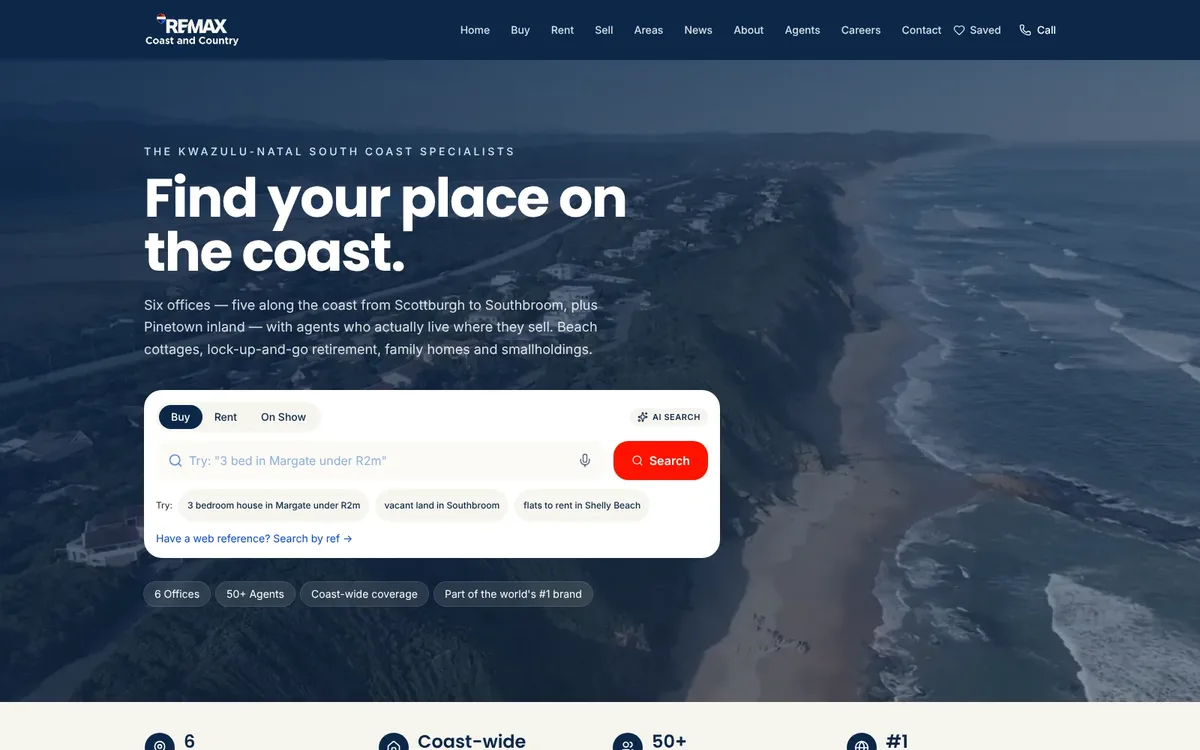
We built the platform for RE/MAX Coast & Country, a six-office franchise on the KwaZulu-Natal South Coast with more than 1,400 live listings. These are the requirements that turned out to matter, in the order a buyer notices them.
1. Your own listings database, synced on a schedule
The website should never query the feed while a buyer waits. We keep a local database of listings and sync it from the Hub on a schedule — hourly in this case — so search is instant, filters are consistent, and a slow or briefly unavailable feed is invisible to the public. New listings normally appear within an hour of becoming available in the feed, once the sync completes; price and status changes follow the same path.
The sync is a diff, not a wipe-and-reload. A listing that disappears from the feed is marked withdrawn rather than deleted, so a buyer who saved it last week lands on a sensible page instead of a 404, and the office keeps its history.
2. The reference number is a first-class address
Every RE/MAX listing has a reference. Buyers see it on boards, in print and in WhatsApp messages, and agents quote it on the phone. Reference-number search gives buyers a direct route from a board, a message or a conversation to the property, and the property's URL contains the reference, so a link shared today still works after the title changes.
3. Search the way buyers actually ask
The filter bar is necessary and not sufficient. People think "3 bed in Margate under R2m", not "property type: house; bedrooms: 3+; suburb: Margate; maximum price: 2 000 000". We put a natural-language search beside the conventional filters. A model translates the sentence into filters, the filters query the local database, and the buyer sees the parsed intent — "3+ beds, under R2,000,000, Margate" — so they can correct it. The model never invents a property; every result is a real listing.
4. Agents and offices are part of the data, not an afterthought
A franchise sells through people. Each listing is tied to its agent and office from the feed, so the property page shows who to call, with one-tap call and WhatsApp, and a request form that already carries the reference and title. Agent and office pages are generated from the same data, which means they are always complete and never maintained by hand.
5. Monitoring, because a silent feed is the worst feed
The failure that hurts is not an outage; it is a feed that keeps running with stale data for a week while nobody notices. Every sync run is logged with its counts — added, updated, withdrawn, failed — and an alert is raised when a run fails or the counts fall outside the normal range. The marketing team can also check any listing in the admin panel and compare it with the Hub, which ends the "is it the feed or the website?" conversation.
6. Images handled properly
A listings feed ships hundreds of photos an hour. Store them, resize them for cards and galleries, serve modern formats, and lazy-load below the fold. A property page with forty photos should not cost a buyer on a phone forty full-size downloads. This is where a listings site most easily loses its speed, and speed matters to buyers as well as to search engines.
7. The paperwork
Access to the Hub feed is granted, not assumed. The franchise needs the data agreement with the feed's provider in place, and the national brand's approval of the site design before launch. Both take longer than the build if you start them last. We now raise them in the first week.
What this buys the office
For Coast & Country the result is a site that stays in step with the Hub without anyone touching it, a search that answers plain questions, and a marketing team that can see for themselves that a listing is live. The case study shows the buyer's journey from the first search to the agent's phone number. If you run a RE/MAX office, or any franchise that sells from a central feed, this is the checklist we would bring to the first conversation.
Frequently asked
How quickly does a new listing appear on the website?
Normally within an hour of it becoming available in the RE/MAX Hub feed, once the scheduled sync completes, without anyone re-keying it.
Can a franchise website work without the Hub feed?
It can launch from a one-off export, which is how we go live before the feed integration is complete, but it cannot stay accurate that way. Daily manual uploads are not a plan.
Who approves the website?
The national brand approves the design and the franchise signs the data agreement for the feed. We build both steps into the project plan from the start.